|
|
|
|
Original Article
Exploring Gender Differences in Entrepreneurial Skills of Under Graduation Students in Selected Government First Grade Colleges of Karnataka
|
Girisha K. R.
1*, Sarala K. S. 2 1 Research Scholar and
Assistant Professor, Smt. and Sri YER Govertment
First Grade College, Pavagada, Karnataka, India 2 Professor, Department of Commerce, Sahyadri
Commerce and Management College, (A Constituent College of Kuvempu University, Shivamogga, Karnataka, India |
|
|
|
ABSTRACT |
||
|
Gender has emerged as an important dimension in entrepreneurship research influencing access to opportunities, resources and skill development. But, the level of women participation in entrepreneurship in India remains comparatively low as reflected by Global Entrepreneurship Monitor Report (2022) NITI Aayog Report (2023). The study, in this backdrop intends to examine whether entrepreneurial skills differ significantly based on gender among under graduation students, focusing on risk-taking ability, leadership skills, creativity and innovation. Primary data have been collected using a structured questionnaire with 14 Likert-scale items from final-year BA, BCom and BSc students in selected Government First Grade Colleges across Tumakuru, Davanagere and Chikkaballapura districts for a sample size of 140. The study employed an independent samples Welch’s t-test to analyse gender differences, while Hedges’ g was used to measure effect sizes and Holm’s correction was applied to adjust p-values for more robust statistical inference. The study findings reveal significant gender differences across all three mentioned dimensions, with large effect sizes indicating a substantial gap in entrepreneurial competencies. The study underscores the need for targeted interventions to enhance women’s entrepreneurial skills and promote balanced as well as inclusive entrepreneurial development among female students in particular. Keywords: Creativity and Innovation,
Entrepreneurial Skills, Gender, Risk, Taking Ability, Leadership Skills |
||
INTRODUCTION
Entrepreneurship
plays a crucial role in promoting economic growth, employment generation and
innovation, particularly in emerging economies like India. In recent years, the
country has witnessed a rapid expansion of its entrepreneurial ecosystem,
supported by favourable government policies, improved access to banking and
financial resources and a growing culture of creativity and innovation which
have encouraged individuals from diverse socio-economic backgrounds to engage
in entrepreneurial activities and contribute to the nation’s economic
development. To succeed in such dynamic
environments, entrepreneurs must possess a set of specialized competencies in
the form of entrepreneurial skills such as risk-taking ability, leadership,
creativity, decision-making and networking which play a critical role in
determining entrepreneurial success and have therefore attracted significant
attention in both academic research and policy discourse.
Traditionally,
entrepreneurship in India has been perceived as a male-dominated domain due to
socio-cultural norms, limited mobility and restricted access to financial and
institutional support for women. However, over the past decade, there has been
a noticeable increase in women participation in entrepreneurial activities
driven by improved education, digital inclusion and targeted policy initiatives
promoting women empowerment.
Despite these
advancements, the level of women participation in entrepreneurship in India
remains comparatively low. Available statistics present a nuanced picture
depending on the measurement criteria. Studies indicate that women constitute
approximately 13%-14% of total entrepreneurs in India, reflecting a significant
under representation in entrepreneurial activity. [1] At the enterprise level, women own around
20% of businesses while their share in the Micro, Small and Medium Enterprises
(MSME) sector is estimated at about 22% as highlighted in recent national
economic reports. [2] In the startup ecosystem which represents
high-growth and innovation-driven ventures, women participation is even lower,
with only 9%-14% of start-up founders being women[3] which is an indication that although women
are increasingly entering entrepreneurship, their presence remains limited
particularly in high-growth and scalable ventures.
Review of Literature
Krishna
and Agrawal (2026) found that educational support positively
shapes entrepreneurial attitude, subjective norms and perceived behavioural
control, though the strength of these relationships varies by gender and
cultural context. Overall, the study shows that entrepreneurial intentions are
shaped by cultural and gender differences, highlighting the need for
context-specific and inclusive entrepreneurship education policies.
Behr
and Xi (2026) Identifies four major challenges-
institutional barriers, financial constraints, human capital gaps and social
and cultural norms. By using World Bank data, the authors suggest to reduce
these barriers through increased women participation in entrepreneurship and
labour participation. It concludes that creating a supportive and enabling
environment is essential for women to succeed in entrepreneurship.
Puente
Pacheco (2025) examines the role
of gender in entrepreneurship education and its influence on business success and investigates
gender-specific patterns of participation in entrepreneurship education
programmes and their impact on business growth. Results reveal that significant
gender-based differences in access to entrepreneurship education programmes
demonstrate a positive relationship between educational participation and
business success with varying effects between male and female entrepreneurs.
Moraes
et al. (2024) analyse gender-based differences in the
influence of entrepreneurial characteristics on entrepreneurial intention among
students in technological colleges in a developing country. The findings reveal
significant gender differences in the determinants of entrepreneurial intention
and suggest that entrepreneurial intentions are shaped by distinct
entrepreneurial characteristics across genders.
Chaker
and Elyetim. (2024) examine how gender, prior work experience,
social work affiliation and family role models influence the development of
entrepreneurial skills among students and the findings show that prior work
experience and social work significantly enhance certain entrepreneurial
competencies, while men demonstrate slightly higher development in some skills
compared to women.
Santos-Jaén
et al. (2022) concentrated on gender differences in entrepreneurial competencies and
entrepreneurial self-efficacy among middle school students participating in an
entrepreneurship education programme. Although entrepreneurship is often
perceived as a male-dominated domain, research suggests that girls demonstrate
strong competencies such as collaboration, creativity and practical planning as
critical predictors of entrepreneurial success.
The
OECD Report (2021) focuses on
the effectiveness of women entrepreneurship policies, emphasizing both targeted
initiatives and the need to make mainstream policies more gender-inclusive.
Drawing on insights from global experts, including contributions from the
Global Women’s Entrepreneurship Policy Research Project, it underscores that
challenges were intensified by COVID-19 pandemic and calls for more effective,
gender-sensitive policy design and implementation.
noted that a proportion of female entrepreneurs remains significantly
lower than that of males. The study develops and tests a conceptual model
examining the relationships among entrepreneurial potential, gender and
entrepreneurial intention. The results indicate limited mean differences
between genders, with males reporting higher entrepreneurial intention,
perceived behavioural control and subjective norms, while females exhibited
stronger business-related motives.
Olaniyi
and Lameed (2012) observed gender differences in the acquisition of entrepreneurial
skills among entrepreneurial students and findings revealed that informal
institutional factors such as parental education, socio-economic status and
religious influence have a significant impact on students’ acquisition of
entrepreneurial skills. The study also found that marketing-related values
influencing the choice of entrepreneurial skills were not significantly
associated with gender.
Research Gap
After reviewing
relevant literature on gender and entrepreneurial skills, significant gaps do
remain exist and it is essential to understand gender-based differences in
entrepreneurial skill acquisition and role of higher education institutions to
address this gap and promote entrepreneurial skills among female students. From
in this perspective current study attempt to fill this gap and bridge these
differences, thereby ensuring the balanced and orderly development of
entrepreneurial skills among male and female students.
Research Problem and its Significance
The global
entrepreneurial landscape remains characterized by a persistent gender gap,
where men continue to represent a larger proportion of business owners and
funding recipients. Global
Entrepreneurship Monitor indicates that while female startup rates increased by
four percentage points between 2021 and 2023, for every ten men initiating a
startup, only about eight women do the same. [4] This gap widens significantly in long-term
business sustainability, with men accounting for nearly 67% of established
business owners globally, while women are disproportionately concentrated in
smaller-scale "solopreneurship" or
micro-enterprises, often in traditional sectors like handicrafts and retail. [5] Gender disparity is most severe in
high-growth finance, women are 28% less likely than their male co-founders to
receive venture capital for subsequent ventures and even when funded, they
raise approximately 53% less capital.[6]
In this context,
it is essential to understand the underlying reasons for gender inequalities
and the low participation of women in entrepreneurial activities. Accordingly,
the present study examines gender differences in entrepreneurial skills among
male and female students, with specific emphasis on risk-taking ability,
leadership, creativity and innovation skills.
Research Objectives
·
To
understand the level of Risk-Taking Ability among male and female under
graduation students
·
To
examine gender differences in Leadership Skills among under graduation students
·
To
analyse whether Creativity and Innovation do differ based on gender
Research Hypotheses
Hypothesis 1:
H0: There is no
significant difference in Risk-Taking Ability of male and female under
graduation students
H1: There is a
significant difference in Risk-Taking Ability between male and female under
graduation students
Hypothesis 2:
H0: There is no
significant difference in Leadership Skill of male and female under graduation
students
H1: There is a significant difference in
Leadership Skill of male and female under graduation students
Hypothesis 3
H0: There is no
significant difference in Creativity and Innovation of male and female under
graduation students
H1: There is a
significant difference in Creativity and Innovation of male and female under
graduation students
Type of Research
The study adopts
an explanatory research design to not only identify the existence of
gender-based differences in entrepreneurial skills but also to examine the
relationships between gender and the key variables considered. Furthermore, it
seeks to propose suitable measures to address these differences and promote the
balanced and systematic development of entrepreneurial skills across genders.
Scope of the Study
The study considers three Urban Government First
Grade Colleges from Tumakuru, Davanagere
and Chikkaballapura districts and were randomly
selected as sample institutions, ensuring that each college has more than 10
years of establishment and offering B.Com, B.A and B.Sc
programmes to a diverse student population
intended to understand the gender
based differences in entrepreneurial skills among final year undergraduate male and female students of sample colleges.
Sample Design
Researcher has
used convenience sampling method for drawing a sample of 140 respondents from
three government first-grade colleges as specified in the scope with 70 male and 70 female students. A total of 49, 52 and 39
respondents from GFGC Davangere, Doddaballapur and Tumkur are
respectively considered as sample respondents for the research purpose.
Sources of Data and Survey Instrument
Primary data were collected using a structured
student questionnaire from selected students of sample colleges and Secondary
data from relevant books, reports, research journals and websites to support
and supplement the primary findings. A total of 14 Likert based questions were
designed for the questionnaire asking the respondents to rank their importance
of agreement on a scale of 1 to 4 with 1 ‘Strongly Disagree’ and 4 as ‘Agree’.
Statistical Analysis
The study utilized
descriptive statistical techniques with the percentage method applied to
analyse demographic characteristics of respondents and employed an independent
samples Welch’s t-test to examine gender-based differences in entrepreneurial
attributes between male and female students, Welch’s t-test was selected as it
is robust to unequal sample sizes and heterogeneity of variances. In addition
to statistical significance testing, Hedges’ g was calculated to assess the
magnitude of gender differences by estimating effect sizes, p-values were
adjusted using Holm’s correction method, thereby ensuring more reliable and
conservative statistical inferences.
|
Table 1 |
|
Table 1 Key
Entrepreneurial Skill Factors and Their Measurement Indicators |
|
|
Factor |
Item/Indicators |
|
·
Handle uncertainty in business situations |
|
|
Risk-Taking Ability |
·
Comfortable making decisions
even when outcomes are unclear |
|
·
Willing to invest time or money in a business
idea despite risks |
|
|
·
Failure as a learning
opportunity rather than a loss |
|
|
·
Willing to take risks to start a new venture |
|
|
·
Motivate others to achieve
common goals |
|
|
Leadership Skill |
·
Feel confident leading a team |
|
·
Delegate tasks effectively
among team members |
|
|
·
Take responsibility for team outcomes |
|
|
·
Resolve conflicts within a
group |
|
|
·
Generate new ideas for products or services |
|
|
Creativity and Innovation |
·
Enjoy finding innovative
solutions to problems |
|
·
Think differently from others while solving
problems |
|
|
·
Often suggest new ways of
doing things |
|
|
·
Combine existing ideas to create something new |
|
|
Source Student Questionnaire |
|
The survey
conducted through structured questionnaire with 140 responses were recorded and
the data have been analysed and presented as under.
Descriptive Statistics
|
Table 2 |
|
Table 2 Demographic
Profiles of Respondents |
|||
|
Demographic Feature |
Particulars |
Responses |
Percentage |
|
Gender |
Male |
70 |
50 |
|
Female |
70 |
50 |
|
|
Others |
-- |
-- |
|
|
Total |
140 |
100 |
|
|
|
18-20 |
64 |
45.71 |
|
Age |
20-22 |
76 |
54.29 |
|
|
Total |
140 |
100 |
|
Academic Stream |
Commerce |
54 |
38.57 |
|
Arts |
48 |
34.28 |
|
|
Science |
38 |
27.14 |
|
|
Total |
140 |
100 |
|
|
Academic Programme |
B. Com |
54 |
38.57 |
|
B. A |
48 |
34.28 |
|
|
BSc |
38 |
27.14 |
|
|
Total |
140 |
100 |
|
|
Occupation (Father) |
Agriculture |
84 |
60 |
|
Employee |
38 |
27.14 |
|
|
Self employed |
18 |
12.86 |
|
|
Total |
140 |
100 |
|
|
|
Home Maker |
114 |
81.4 |
|
|
Agriculture |
26 |
18.56 |
|
Occupation (Mother) |
Business |
- |
- |
|
|
Others (Specify) |
- |
- |
|
|
Total |
140 |
100 |
|
Family Background |
Agriculture |
112 |
80 |
|
Business |
28 |
20 |
|
|
Total |
140 |
100 |
|
|
Source Survey Data |
|||
Demographic data
reveals that regarding gender representation 50% respondents are male, more
than 50% are
under 20-22 years, nearly 39% are from commerce stream, 60% respondents
fathers are into agriculture, more than 80% respondent’s mothers are home
makers and only 20% of respondent families have business background.
|
Table 3 |
|
Table 3 Gender-wise
Comparison of Entrepreneurial Attributes Using Welch’s t-test |
||||||||||
|
Scale |
n_male |
mean_male |
sd_male |
n_female |
mean_female |
sd_female |
welch_t |
p_value |
hedges_g_m_minus |
p_value_holm |
|
Risk_mean |
90 |
3.937 |
0.104 |
50 |
1.448 |
0.425 |
40.746 |
0 |
9.284 |
0 |
|
Lead_mean |
90 |
3.839 |
0.159 |
50 |
1.098 |
0.265 |
66.711 |
0 |
13.42 |
0 |
|
Creativity_mean |
90 |
3.806 |
0.157 |
49 |
1.715 |
0.51 |
27.977 |
0 |
6.351 |
0 |
|
(Source: Results of
Welch’s t-test) |
||||||||||
|
Figure 1 |
|
|
|
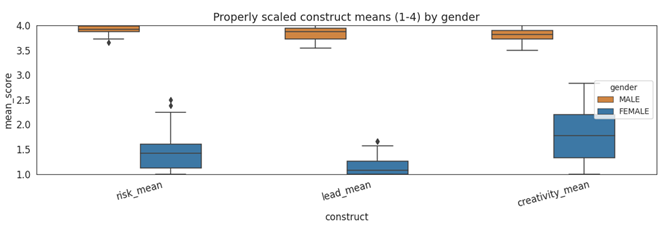
Figure 1 Gender-wise Comparison of Entrepreneurial Attributes Source Results
of Welch’s t-test |
Across all
constructs-Risk-taking, leadership, creativity and innovation and the combined
overall score the differences are statistically significant (p-values
essentially 0 even after Holm correction). Directionally, the mean scores are
higher for Male than Female for every construct in this computed scoring.
Effect sizes (Hedges’ g) are also very large, suggesting that the difference is
not just statistically significant but also practically huge given the way
these scores were computed.
Hypotheses Testing
Hypothesis 1:
H0: There is no
significant difference in Risk-Taking Ability of male and female under
graduation students
H1: There is a
significant difference in Risk-Taking Ability between male and female under
graduation students
For Risk_mean (risk-taking ability), Table 3 shows that male
students have a mean score of approximately 3.94 on a 1–4 scale, indicating
strong agreement with risk-taking items, whereas female students have a mean
score of about 1.45, reflecting responses closer to disagree or neutral. This
substantial difference suggests that male students exhibit significantly higher
risk-taking ability compared to female students. The independent samples
Welch’s t-test confirms that this difference is statistically significant (p
< 0.001), with a very large effect size (Hedges’ g = 9.284). Hence, the null
hypothesis (H₀₁), which assumes no significant gender difference in
risk-taking ability, is rejected.
Hypothesis 2:
H0: There is no
significant difference in Leadership Skill of male and female under graduation
students
H1: There is a significant difference in
Leadership Skill of male and female under graduation students.
Table 3 presenting
mean scores on the leadership dimension (measured on a 1–4 scale) indicate a
substantial gender difference. Male students have a mean score of approximately
3.84, whereas female students have a mean score of about 1.10, representing an
even larger gap than that observed for risk-taking ability. The results of the
independent samples Welch’s t-test reveal a very large t-statistic with a
p-value close to zero (p < 0.001), confirming that the difference in average
leadership scores between male and female students is statistically
significant. Overall, the findings indicate that male students demonstrate
significantly higher leadership ability compared to female students.
Hypothesis 3
H0: There is no significant difference in
Creativity and Innovation of male and female under graduation students
H1: There is a
significant difference in Creativity and Innovation of male and female under
graduation students
The group mean
scores for the creativity and innovation dimension, measured on a 1–4 scale,
reveal a clear gender difference. Male students report a mean score of
approximately 3.81, clustering around the “Agree” to “Strongly Agree”
categories, whereas female students have a mean score of about 1.72, indicating
responses closer to “Neutral” or “Disagree.” The independent samples Welch’s
t-test indicates that this difference is statistically significant, with a
p-value close to zero (p < 0.001). In addition to statistical significance,
the effect size measured by Hedges’ g is very large, suggesting that the
observed difference is also practically meaningful. Overall, the results
indicate that male students demonstrate significantly higher creativity and innovation
scores than female students.
Major Observations
Data analysis
reveals a substantial gender disparity in key entrepreneurial skills, with men
significantly outperforming women across all three dimensions—risk-taking,
leadership ability and creativity. The gap is most pronounced in leadership,
followed by risk-taking, while creativity shows a comparatively moderate
difference. The very high effect sizes and statistically significant results
indicate that these differences are not marginal but structurally strong. This
suggests that women may face limitations in developing critical entrepreneurial
competencies, particularly in areas requiring decision-making under uncertainty
and leadership roles. Therefore, targeted interventions focusing on enhancing
women’s confidence, leadership exposure and risk-taking capacities are
essential to bridge this gap and promote inclusive entrepreneurial development.
Suggestions
·
Strengthening
Risk-Taking Ability
Enhancing women’s
risk-taking ability in entrepreneurship requires a practical and supportive
approach that builds both competence and confidence, achieved through
simulation-based training such as business games and startup labs, along with
financial literacy and risk management workshops organised by higher education
institutions to support informed decision-making.
·
Enhancing
Leadership Skills
To strengthen
women leadership abilities in entrepreneurship, it is essential to provide
structured opportunities for skill development and exposure. Leadership
programmes arranged by higher education institutions focusing on communication,
negotiation and team management can build core competencies. Also encouraging
participation in women-led projects, clubs and startup teams enhances practical
experience and role model sessions with successful women entrepreneurs can
inspire by demonstrating achievable pathways to success.
·
Improvement
Creativity and Innovation
Design thinking and innovation workshops can
build structured problem-solving skills, while participation in hackathons,
idea competitions and incubation centres fosters practical exposure and an
innovative mindset. Interdisciplinary learning environments encourage diverse
perspectives, and problem-based learning further strengthens critical thinking
and the ability to develop effective real-world solutions, the higher education
institutions need to focus on these aspects.
·
Networking
and Institutional Support from Higher Education Institutions
Higher education institutions can play a key
role by establishing women-focused entrepreneurship cells or incubation
centres, offering internships with startups and women-led enterprises and
integrating entrepreneurship education into the curriculum with practical
exposure. In addition, facilitating industry interaction programmes, networking
events, supporting participation in entrepreneurship summits and workshops and
fostering peer learning communities among women students can significantly
enhance exposure, collaboration and entrepreneurial growth.
Conclusion
Bridging the
gender gap in entrepreneurial skills is essential for achieving inclusive and
sustainable economic development. The existing disparities in risk-taking,
leadership, creativity and confidence highlight the need for targeted and
systematic interventions. By fostering skill development through practical
training, mentorship, institutional support and exposure opportunities, women
can be empowered to overcome structural and societal barriers. Creating an
enabling ecosystem that nurtures their potential will not only enhance
individual entrepreneurial capabilities but also contribute to broader economic
growth, innovation and social progress.
ACKNOWLEDGMENTS
None.
REFERENCES
Agrawal, R., Bakhshi, P., Chandani, A., Birau, R., and Mendon, S. (2023). Challenges Faced by Women Entrepreneurs in South Asian Countries Using Interpretive Structural Modelling. Cogent Business and Management, 10(3). https://doi.org/10.1080/23311975.2023.2244755
Alexeeva-Alexeev, et al. (2025). Influence of Socio-Economic Factors on Female Entrepreneurship: An Analysis Using Structural Equation Modelling (PLS-SEM). Frontiers in Sociology. https://doi.org/10.3389/fsoc.2025.1684697
Behr, D. M., and Xi, Y. (2026). Closing the Gender Gap in Entrepreneurship: Overcoming Challenges in Law and Practice for Female Entrepreneurs (Policy Research Working Paper No. 11281). World Bank. https://doi.org/10.1596/1813-9450-11281
Chaker,
and Elyetim. (2024). Practice, Observation, and Gender Effects on Students'
Entrepreneurial Skills Development
When Teaching Through Entrepreneurship is Adopted: Case of University of Tunis El
Manar. International Journal of Learning, Teaching
and Educational Research.
Charantimath, P. (2012).
Entrepreneurship Development
and Small Business Enterprises. Pearson Education.
Cherunilam, F. (2012). Business Environment: Text and Cases. Himalaya Publishing House.
De la Puente Pacheco, M. A., Torres, J., Cantillo Padron, J. C., Pacheco Barros, M. C., and Rico, H. (2025). Analysing the Role of Gender in Entrepreneurship Education and Economic Success in Developing Nations: The Case of Colombia. Cogent Business and Management, 12(1), Article 2457476. https://doi.org/10.1080/23322039.2025.2457476
Desai, V., and Kaur, K. (2015). Entrepreneurship Development and Management. Himalaya Publishing House.
Hebert, C., Tookes, H., and Yimfor, E. (2024). Financing the Next VC-Backed Startup: The Role of Gender. SSRN Electronic Journal. https://doi.org/10.2139/ssrn.4784414
Krishna, S. M., and Agrawal, S. (2026). Entrepreneurial Intentions: The Role of Gender and Culture in Entrepreneurial Education. Administrative Sciences, 16(1), 38. https://doi.org/10.3390/admsci16010038
Lambon-Quayefio, M., Asiedu, E., Truffa, F., and Wong, A. (2025). Gender Gaps in Entrepreneurship: Business Networks and Collaborations in Ghana. AEA Papers and Proceedings, 115, 495–499. https://doi.org/10.1257/pandp.20251069
Mathur,
A. (2020).
Entrepreneurial Development. Taxmann Publications.
Ministry of Statistics and Programme Implementation. (2025). Sixth Economic Census: Gender-Disaggregated Data on Indian Enterprises. Government of India.
Olaniyi, I. M., and Lameed, S. N. (2012). Gender Differences in Entrepreneurial Skills’ Acquisition: An Analysis of Informal Institutional Factors. IOSR Journal of Business and Management, 2(6), 24–30. https://doi.org/10.9790/487X-0262426
Santos-Jaén, J. M., Iglesias-Sánchez, P. P., and Jambrino-Maldonado, C. (2022). The Role of Gender and Connections Between Entrepreneurship and Employability in Higher Education. The International Journal of Management Education, 20(3), 100708. https://doi.org/10.1016/j.ijme.2022.100708
Ward, A., Hernández-Sánchez, B. R., and Sánchez-García, J. C. (2019). Entrepreneurial Potential and Gender Effects: The Role of Personality Traits in University Students' Entrepreneurial Intentions. Sustainability, 11(24), 6860. https://doi.org/10.3390/su11246860
|
|
 This work is licensed under a: Creative Commons Attribution 4.0 International License
© ShodhPrabandhan 2026. All Rights Reserved.