|
|
|
|
Challenges to Psychological Wellbeing among Students in Multicultural Environments: The Role of Emotional Intelligences
Rokhiya Tasneem 1, Dr. Vandana Vashisth 2, Dr. Vimlesh Tanwar 3
1 Research
Scholar, Department of Commerce and Management, Banasthali
Vidyapith, Jaipur, Rajasthan, India
2 Assistant
Professor, Department of Commerce and Management, Banasthali
Vidyapith, Jaipur, Rajasthan, India
3 Assistant Registrar, Banasthali Vidyapith, Jaipur, Rajasthan, India
|
|
|
ABSTRACT |
|
|
Purpose This study examines the relations among intercultural problems, emotional intelligence, and university students' psychological well-being from diverse academic settings. The objective of the present study is to investigate the mediation and moderation role of emotional intelligence in the influence that multicultural stressors, such as cultural adjustment problems, communication difficulties, and social integration challenges, may have on the students' psychological well-being and adaptability. Design/methodology/approach
A quantitative cross-sectional design was adopted, where a total of 384 undergraduate and graduate students from various universities participated. Data collection was done by standardized tools to assess issues related to multiculturalism, emotional intelligence, and psychological well-being. SEM was applied in this research to test various direct, mediation, and moderation effects that the components had. Findings The findings have revealed negative impacts of multicultural problems on students' psychological well-being; at the same time, emotional intelligence plays an important role in mediating or moderating this relationship. Emotionally intelligent students are better able to manage their emotions, empathize with others, and bounce back from adversity; as a result, they are more equipped to navigate the challenges presented by social and cultural diversity. Low levels of emotional intelligence have been found to raise stress and reduce wellbeing within intercultural settings. Originality/value
This research
extends the literature on intercultural education by underlining emotional
intelligence as an important psychological resource. It offers practical
implications for educators and policy makers in the design of culturally
sensitive treatments and emotional intelligence training programs that aim to
advance mental health, inclusivity, and cross-cultural cohesion in school
settings. |
|||
|
Received 28 March 2025 Accepted 29 April 2025 Published 31 May 2025 DOI 10.29121/ShodhPrabandhan.v2.i1.2025.59 Funding: This research
received no specific grant from any funding agency in the public, commercial,
or not-for-profit sectors. Copyright: © 2025 The
Author(s). This work is licensed under a Creative Commons
Attribution 4.0 International License. With the
license CC-BY, authors retain the copyright, allowing anyone to download,
reuse, re-print, modify, distribute, and/or copy their contribution. The work
must be properly attributed to its author.
|
|||
|
Keywords: Emotional Intelligence, Psychological Well-Being,
Multicultural Challenges, Student Adaptation, Cultural Diversity |
|||
1. INTRODUCTION
In this globalized era, educational institutions have become multicultural environments where different students come together, representing their diverse linguistic, cultural, and ethnic backgrounds. Classrooms do not represent homogenous groups, rather, they reflect the interdependence of a multi-national society. This may definitely help to enrich the learning environment by encouraging creativity, tolerance, and intercultural understanding. On the other hand, the complicated emotional and psychological issues that come with diversity may affect students' emotional and psychological health. Students within any given multicultural environment are constantly being put out of their comfort zone in order to get used to other social norms, modes of communication, and cultural expectations, in addition to academic challenges and personal growth. The process of adaptation can be emotionally burdensome and, when poorly handled, leads to stress, isolation, and diminished psychological well-being González-Castro et al. (2020). So, being able to control one's emotions and react empathetically to other people is crucial for being flexible and successful.
Psychological well-being encompasses an individual's mental health, self-acceptance, sense of purpose, and resistance against stress. Psychological well-being is important for students in order to stay motivated, socially connected, and to achieve school success Xiaoying et al. (2023). In a multicultural learning environment, well-being may be threatened by cultural distance, identity crisis, language barriers, and differences in behavioral conduct. Acculturative stress, homesickness, and social loneliness are common challenges faced by international students in their study-abroad experiences. Local students may also face challenges in negotiating social relationships in schools that are culturally diverse. The associated pressure can therefore inhibit social inclusion, emotional stability, and academic participation Moeller et al. (2020). Knowing how students maintain their psychological well-being within a multicultural environment thus forms one very important basis on which supportive and inclusive learning environments can be established.
Emotional Intelligence represents an important psychological resource for dealing with stress and enhancing one's mental health. To be emotionally intelligent is to be able to read and manage one's own and other people's emotion. Goleman Çarkçı (2024) concept of emotional intelligence includes the following five components: capacities for self- awareness, control, inspiration, compassion, and communication. In the multicultural learning environments, these competencies enable students to recognize different emotional signals and to communicate across cultures, as well as to establish relevant interpersonal relationships. A high-EQ individual is likely to enjoy support networks, keep their cool under pressure, and adapt well to challenges related to culture. Poorly developed emotional intelligence predisposes students to act impulsively, misread emotional signals, and fail to cope with cultural issues.
Empirical research has shown that emotional intelligence significantly enhances both the psychological well-being and adjustment of individuals within academic settings Tajvar et al. (2024). Students who score higher on the emotional intelligence test tend to be more resilient and less prone to worry because they are better able to understand and manage their emotions. Emotional intelligence thus enables an individual to evaluate experiences positively, reduce negative self-feelings, and increase self-esteem MacCann et al. (2020). Such competencies are required in multicultural contexts because they facilitate tolerance for empathy and cultural sensitivity, which are decisive competencies in communication and cooperation across cultural boundaries. As such, emotional intelligence could buffer pupils' mental health against cultural stress by helping them develop tolerance and emotional stability.
Although important, emotional intelligence has often been neglected in traditional curricula that stress cognitive abilities and academic success over emotional development Hong et al. (2021). Most schools fail to prepare students well for the emotional and social challenges that they are likely to face within the culturally diverse atmosphere; such students can easily fall into emotional turmoil, identity confusion, or social withdrawal. Teachers could therefore improve the capacity of students in emotional management, social harmony, and psychological wellbeing through emotional intelligence training D’souza et al. (2023). As colleges continue to diversify further, discovering the potential for emotional intelligence to improve mental health and ease adaptation to cultural differences is becoming more and more significant.
Emotional intelligence and mental health are connected with each other in a very complicated way in the multicultural context. Emotional intelligence influences the students' abilities to deal with such feelings of anxiety, irritation, or loneliness that may accompany cultural transition. It inspires openness and receptivity toward lots of ideas, which enables kids to make multicultural friendships and a sense of belonging. Both individuals' mental health and a more harmonious and emotionally friendly educational environment benefit from this link between emotional intelligence and wellbeing Al-Qadri and Zhao (2021). However, a lack of emotional intelligence may cause students to misunderstand more easily, experience more emotional depression, and have less positive views of their own sense of belonging. The present study examines the challenges to kids' mental health in multicultural classrooms and how emotional intelligence might help them thrive despite these obstacles. Despite various studies focusing on the correlation between EQ and mental health in recent years, this topic has received less consideration within multicultural academic contexts. This question is relevant and timely in view of the fact that education has taken on a global dimension, especially higher education. It will help educators, counselors, and policy makers understand this relationship with a view to creating programs aimed at enhancing emotional competence, building multicultural understanding, and encouraging student mental health. It would also help them turn diversity from what can often be a source of stress into an opportunity for emotional development and resilience, growth in general.
Examining the effects of ethnically different educational settings on students' emotional intelligence and psychological well-being is the driving force behind this study. The current study also achieves what was missing in the literature because it brings emotional intelligence together with mental health to explore the relationship between these two factors in culturally diverse educational contexts. Emotional intelligence is emphasized as crucial for acculturative stress management, resilience training, and social integration. This paper contributes to developing emotionally supportive, inclusive, culturally responsive educational frameworks, which inform educators and policymakers about the process of psychological adaptation of students in multicultural classrooms.
1.1. Objectives
· To examine the relationship between multicultural challenges, emotional intelligence, and students’ psychological wellbeing.
· To investigate the moderating role of emotional intelligence in the relationship between multicultural challenges and psychological wellbeing among students.
2. Literature review
Piñeiro-Cossio et al. (2021) investigated approaches to mental health in this area. They searched WOS, SPORT Discus, SCOPUS, and ERIC for psychological health, physical education, and school sports literature. Finding significant variation in treatment durations, it used both traditional and novel forms of physical activity, games, and sports to improve students' mental health in secondary school. Psychological well-being measuring methods differ owing to conceptual disagreement. Research ties psychological well-being to self-determination and essential needs. a data-driven concept of psychological well-being and physical exercise.
Blasco and Alsinet (2022) Mental health research emphasizes well-being. The Psychological Well-Being Scale (PWBS) has inconsistent theoretical and empirical outcomes, making measuring difficult. Emergent networks describe psychological processes. exploratory graph analysis of 1,404 random Spanish 29-item PWBS networks. LASSO created item- and dimension-level regularized partial correlation networks. Studying network stability and fundamental components. Acceptance of oneself, a feeling of direction in life, and mastery over one's environment are fundamental to the PWBS network paradigm. When it comes to PWBS mental health, self-acceptance ranks highest, as shown by node strength centrality. An alternative to Ryff's concept of psychological health that proposes treatments for mental illness is a network model.
Tran et al. (2022) examined pupils for psychological well-being, distress, and related issues. A survey measuring research satisfaction, anxiety, stress, depression, and psychological health. Their methods were hierarchical regression and descriptive statistics. Out of 28,355 invited students, 915 (or 32% of the total) filled out the survey in October 2019. The results showed that a lower score indicated psychological well-being (β = 0.70, p < 0.001), whereas a higher score was associated with academic dissatisfaction, sadness, anxiety, and tension (β = -0.26, p < 0.001). High predictor of anxiety, stress, but not depression or well-being. Mental health improves with age. Educational background and year hardly affect mental health. Education affects depression, anxiety, and stress. Schools must address student dissatisfaction and provide psychosocial support to alleviate psychological distress.
Chaudhry et al. (2024) investigated four support types and management students' mental health. Examining academic engagement intervention. Structured equation modeling and hierarchical regression analysis of 309 Indian university management students show considerable internal cooperation. Environment, school, and family support improve children' mental health. well-being. Internal interactions may improve with academic participation. Family support and teamwork affect mental health. Thought completely mediates institutional support. and mental health. that teamwork and institutional support influence academic engagement and mental health. Schools may improve student mental health.
Hammoudi et al. (2023) student mental health issues included stress, exhaustion, worry, and despair. Educators' mental health may be impacted by the many personal and professional responsibilities they have, including teaching, research, mentoring, professional development, and service. Research and higher education have undergone fundamental changes. Recent events, teacher and student factors, and COVID-19 have affected academic mental health. Faculty mental health and well-being literature is narratively reviewed in this paper. Academic mental health factors, including anxiety, depression, stress, and burnout across fields and levels. A paradigm shift toward better academic work-life balance and mental wellness whereby faculty and executives collaborate.
Abacioglu et al. (2023) Positive social contacts are essential for students' mental health. Meeting this requirement boosts student engagement, a key predictor of academic achievement. Ethnic minority students still suffer academically due to interethnic antagonism in schools. measure segregated learning environments in multicultural curriculum and teaching and their impact on student performance to solve difficulties. Self-Determination Theory examines how multicultural practices might improve student engagement and how peer connections influence this relationship. Teachers and students analyzed 708 primary school students and 34 instructors to determine how multicultural education impacted student engagement in two classrooms: one with a low minority student concentration and another with a high minority student percentage.
Javaid et al. (2024) evaluated 15 inquiries on the connections between EI, self-concept, and academic accomplishment. Academic success serves as the dependent variable, while emotional intelligence and self-concept serve as the primary independent variables. A concentration on quantitative research methodologies is evident in the instruments utilized, which include MSCIT, TMMS-24, and self-concept assessments. Women tend to have a more positive self-image and higher levels of emotional intelligence (EI) than men do, whereas men tend to be more emotionally clear. In terms of academic performance, these characteristics are highly correlated. Empowering students with disabilities to develop their emotional intelligence and self-concept may help alleviate academic pressure. A person's sense of his or her own intellectual achievement and emotional intelligence.
Fu (2025) analyzed data from 383 STEM instructors throughout China to find out how EQ and mental health affect AI literacy. The Wong and Law Emotional Intelligence Scale, the Meta AI Literacy Scale, and the Psychological Well-being at Work survey were among the instruments used for data gathering. Surveys were backward translated to ensure the accuracy of the measurements. SPSS and AMOS applications were used for the analysis. The results indicated that 71% of the variance in AI literacy is explained by emotional intelligence, while psychological well-being explains 61%. Educational programs that target both mental and emotional well-being may help instructors improve their artificial intelligence abilities, which is crucial for effective technology integration in the learning environment.
Shengyao et al. (2024) Study used a sample from a Chinese university to look at the connection between EQ, positive personality traits, and academic success. Using structural equation modeling, the study analyzed data from 518 undergraduate and graduate students. Emotional intelligence is linked to mental health and academic success, particularly among graduate students, but the impact size is larger overall. There are other variables at work here, including resilience, motivation, and self-efficacy. In order to improve their mental health and academic performance, students may benefit from discovering constructive coping mechanisms.
Molina et al. (2024) Factors such as one's family life, mental health, and emotional intelligence significantly impact the adolescent growth stage. The current research presents the results of an inquiry on 1,092 secondary school students from Spain. The primary objective of the study was to identify gender differences in EQ, family dynamics, psychological health, and academic performance. Students from highly functional homes had greater emotional intelligence and psychological wellbeing compared to those from moderately or severely dysfunctional households. Additionally, these indicators were positively associated with significant gender disparities. Since adolescent growth is heavily influenced by the home environment, steps should be made to enhance psychological wellness.
2.1. Research gap
While numerous research have focused on other aspects of multicultural education, very few have looked at how students' emotional intelligence and psychological health interact with one another. Prior research mostly focused at one student demographic's mental health or one factor's effect on academic performance: emotional intelligence. Little attention has been paid to unique challenges faced within culturally diverse classrooms: language barriers, cultural adjustment, social inclusion, and identity conflicts. Students' mental health may be significantly impacted by multicultural stresses, but the function of emotional intelligence as a moderator has not been well investigated. Very few studies have explored simultaneously the role of familial, peer, and institutional support in influencing the students' psychological well-being in multicultural settings. Thus, there is a pressing need for an integrated approach that will investigate exactly how emotional intelligence might help children navigate intercultural obstacles, build resilience, and secure psychological well-being with the simultaneous accomplishment of academic and social success.
3. Methodology
3.1. Research Design
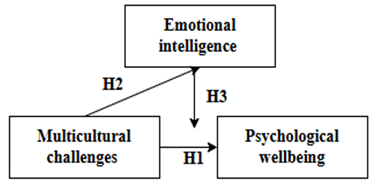
This study used a quantitative cross-sectional research approach to examine the connections between emotional intelligence, psychological health, and intercultural problems. The participants were university students. How EQ mediates the association between intercultural worries and psychological well-being was the focus of the research. The design allowed for hypothesis testing by means of survey data and structural equation modelling to test both direct and interaction effects.
Conceptual
framework
Figure 1
|
Figure 1 Conceptual Framework |
3.2. Population and Sample
The sample was drawn from universities that had multicultural environments. The sample size consisted of 384 students, a size sufficient to allow good representation across gender, age, academic level, years of study, and cultural involvement. Of the total respondents, 50.5% were males and 49.5% females. Age-wise, 25.5% fell into the 18–20 years group, 22.4% in the 21–25 years, 24.2% in the 26–30 years, and 27.9% above 30 years. In terms of their academic standing, 47.9% were undergraduates and 52.1% postgraduates, each year from 1st to 4th relatively equally represented. Degrees of involvement in cultural activities were divided into several levels: 37.5% had minimum engagement, 28.4% moderate involvement, and 34.1% strong participation in intercultural events. This diversified sample made certain that the research would capture a wide diapason of experiences regarding adaptation to multiculturalism, emotional intelligence, and psychological well-being.
3.3. Data Collection Instruments
Data were collected through standardized questionnaires that assessed three broad concepts: emotional intelligence, psychological well-being, and intercultural challenges. For the multicultural problems scale, students were assessed on the difficulty of adapting to an academically different cultural environment through items such as inability to communicate properly, cultural misinterpretation, and poor social adjustment. Indicators of the participants' psychological health included effective stress management, life satisfaction, self-acceptance, and mental wellness. Being emotionally intelligent is being able to read, control, and communicate nonverbal signals about one's own and other people's emotional wellbeing. On a Likert scale ranging from 1 (Strongly Disagree) to 5 (Strongly Agree), each question was scored to assess the level of agreement among the student population.
3.4. Reliability and Validity
Before the hypotheses were tested, the reliability and validity of the instruments were investigated. With Cronbach's alpha values above 0.70, all three assessments—emotional intelligence, psychological wellbeing, and intercultural issues—prove to have strong internal consistency. The results vary from 0.803 to 0.867 for the composite dependability, showing that these questions reliably evaluate the selected components. Also, AVE values for emotional intelligence (0.565), psychological well-being (0.597), and intercultural difficulties (0.792) were all higher than the recommended threshold of 0.50, proving convergent validity. The results also proved that the instruments utilised in this research are reliable and valid and thus formed a sound basis for the succeeding data analysis.
3.5. Data Analysis
Several statistical tools were used to test the
assumptions of the study, including regression analysis, descriptive
statistics, and SEM. Descriptive data on emotional intelligence, psychological
health, and degree of difficulty navigating cross-cultural situations were
generated using a variety of means. The direct correlations between
intercultural issues and psychological wellness and emotional intelligence were
examined in regression study. An examination was conducted to determine the
role of emotional intelligence in mediating the relationship between
intercultural difficulties and psychological well-being. This was achieved by
calculating interaction terms using standardized scores of both emotional
intelligence and intercultural challenges. Model fit indices like CMIN/DF, GFI,
NFI, IFI, CFI, RMR, and RMSEA were generated to assess the structural model
once it had been verified that the latter effectively reflected the
relationship among the study variables.
4. Results
Conceptual framework
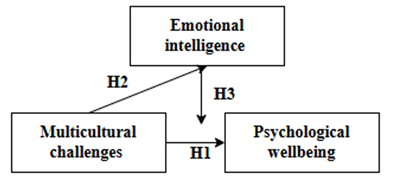
Figure 2
|
Figure 2 Conceptual Framework |
Demographic variables
Table 1
|
Table 1 Demographic Variables |
|||
|
|
|
Frequency |
Percentage |
|
Gender |
Male |
194 |
50.5 |
|
Female |
190 |
49.5 |
|
|
Total |
384 |
100 |
|
|
Age |
18-20 Years |
98 |
25.5 |
|
21–25 Years |
86 |
22.4 |
|
|
26–30 Years |
93 |
24.2 |
|
|
Above 30 Years |
107 |
27.9 |
|
|
Total |
384 |
100 |
|
|
Level of study |
Undergraduate |
184 |
47.9 |
|
Postgraduate |
200 |
52.1 |
|
|
Total |
384 |
100 |
|
|
Years of study |
1st Year |
85 |
22.1 |
|
2nd Year |
95 |
24.7 |
|
|
3rd Year |
102 |
26.6 |
|
|
4th Year |
102 |
26.6 |
|
|
Total |
384 |
100 |
|
|
Cultural Participation |
Low |
144 |
37.5 |
|
Moderate |
109 |
28.4 |
|
|
High |
131 |
34.1 |
|
|
Total |
384 |
100 |
|
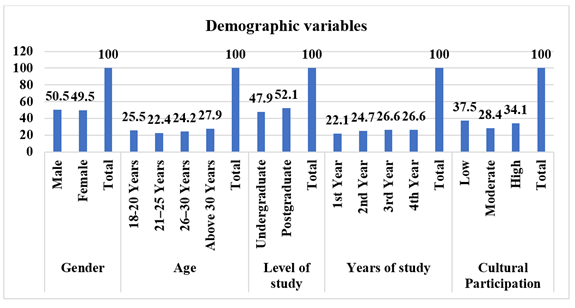
Table 1 shows the demographics of the
384 participants in the study. Gender,
age, education level, and cultural involvement are all fairly distributed. The gender distribution of the participants
was almost even, with 190 females and 194 males making up 50.5% of the total.
The participating students are predominantly in the category above 30 years of
age (27.9%), with other categories close by, such as those aged 18–20 years old
(25.5%), 26–30 years old (24.2%), and 21–25 years old (22.4%), indicating a
good spread in age. Of the participants in the survey, 52.1% were postgraduate
and 47.9% were undergraduates, indicating a near balance with a small
predominance of postgraduate individuals. The participation of students is well
distributed throughout the student academic years, having 22.1% 1st-year
students, 24.7% 2nd-year students, and 26.6% 3rd- and 4th-year students
combined. Regarding the distribution of cultural participation, a total of
37.5% had low, 28.4% moderate, and 34.1% high participation in intercultural
activities, reflecting a varied degree of involvement in cultural experiences.
Based on this statistically valid and representative sample, emotional
intelligence, intercultural adaptability, and psychological well-being among
university students can be assessed.
Table 2
|
Table 2 Validity and Reliability |
|||
|
Variables |
Cronbach’s Alpha |
Composite Reliability |
AVE |
|
Multicultural Challenge |
0.864 |
0.867 |
0.792 |
|
Psychological wellbeing |
0.871 |
0.82 |
0.597 |
|
Emotional intelligence |
0.851 |
0.803 |
0.565 |
Reliability and validity results indicate that the
constructs of the study are internally consistent at high levels and have
satisfactory convergent validity. The following measures are reliable: Measures
of multicultural competence (0.864), psychological health (0.871), and
emotional intelligence (0.851) all have Cronbach's Alpha scores higher than
0.70. The items of each construct show repeated assessment of the same
underlying idea as depicted by the Composite Reliability ratings of 0.867,
0.82, and 0.80, all of which are above the acceptable level of 0.70.
Multicultural Challenge (AVE = 0.792), Psychological Wellbeing (AVE = 0.597),
and Emotional Intelligence (AVE = 0.565) all meet the minimum level suggested
of 0.50, indicating that substantial variance is explained by the constructs
and not measurement error. The set of constructs in the study shows that the
measuring model has validity and is dependable since it applies a comprehensive
and consistent set of constructs.
Table 3
|
Table 3 Mean and Standard Deviation |
||
|
Variables |
Mean |
Std. Deviation |
|
Multicultural challenges |
3.5885 |
0.92082 |
|
Psychological wellbeing |
3.9019 |
0.77620 |
|
Emotional intelligence |
3.9049 |
0.74847 |
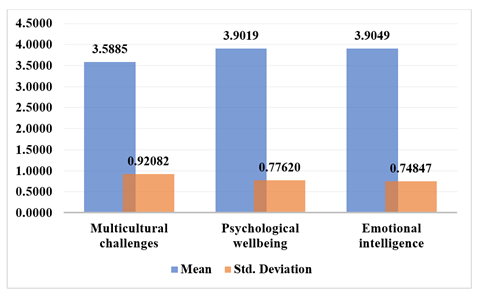
These descriptive statistics thus suggest that,
across the three major variables of emotional intelligence, psychological
wellbeing, and intercultural challenges, participants reported reasonably high
levels with modest variances in their mean scores. The highest of the mean
scores for emotional intelligence was 3.90 (standard deviation = 0.75),
suggesting considerable ability among the respondents to understand and control
their emotions. It seems that most
people have good mental health and are generally satisfied with life since the
mean value for psychological wellbeing was quite high (M = 3.90, SD = 0.78). At
the same time, multicultural issues had a comparatively lower mean score (M =
3.59, SD = 0.92), suggesting that children do have some trouble adjusting to
multicultural environments, but that the difficulty is moderate rather than
severe. The standard deviation values, spanning from 0.74 to 0.92, indicate a
substantial dispersion in replies, implying variety among individuals regarding
their judgements of emotional intelligence, wellbeing, and intercultural
issues. The findings illustrate a cohort of students that sustain emotional and
psychological equilibrium while encountering specific cultural adaptation
problems in a multicultural university environment.
Hypothesis Implementation
H1: Multicultural challenges are negatively related to students’ psychological wellbeing.
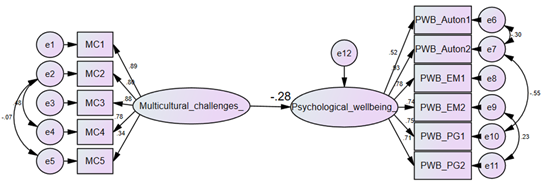
Table 4
|
Table 4 Regression Weights: (Group Number 1 - Default Model) |
||||
|
Path |
Standard Estimate |
S.E. |
C.R. |
P |
|
Psychological wellbeing<--- Multicultural
challenges |
-0.285 |
0.111 |
-3.925 |
*** |
The path analysis findings demonstrate a
substantial inverse relationship between intercultural issues and students'
psychological wellness. The standardised estimate of –0.285 indicates that a
rise in intercultural problems correlates with a decline in psychological
well-being. The negative coefficient indicates that students facing more
challenges in adjusting to multicultural settings such as communication
challenges, cultural misinterpretations, or social adjustment difficulties are
inclined to report diminished psychological health. The critical ratio (C.R.)
of -3.925 and the p-value (p < 0.001) demonstrate that this association is
statistically significant. The results strongly support Hypothesis 1 (H1),
indicating that intercultural barriers negatively impact the psychological
health of students in multicultural university environments.
Table 5
|
Table 5 Model Fit Summery |
|||||||||
|
CMIN |
DF |
CMIN/DF |
GFI |
NFI |
RFI |
IFI |
CFI |
RMR |
RMSEA |
|
57.828 |
38 |
1.522 |
0.974 |
0.976 |
0.965 |
0.991 |
0.991 |
0.042 |
0.037 |
The model fit indices show that the suggested model
is quite close to the data. A
satisfactory fit is shown by the CMIN/DF ratio of 1.522, a Chi-square value
(CMIN) of 57.828 and 38 degrees of freedom (DF). Compared to the target ratio of 3.0, this one
is much lower. This model adequately
explains a substantial amount of the observed data variance, as both the
Goodness of Fit Index (GFI) and the Normed Fit Index (NFI) are more than the
acceptable level of 0.90. Excellent
values over 0.95 are shown by all three fit indices, which further corroborate
the model's strong fit: RFI = 0.965, IFI = 0.991, and CFI = 0.991. Additionally, the RMSEA = 0.037 and RMR =
0.042 are also less than the cutoff of 0.08, indicating a small residual error
and excellent agreement between the model and the data. Based on these findings, it is clear that the
suggested structural model well represents the relationship among EQ,
intercultural competency, and welfare.
H2:
Multicultural challenges are negatively
related to emotional intelligence.
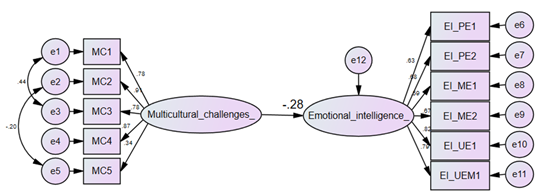
Table 6
|
Table 6 Regression Weights: (Group
number 1 - Default Model) |
||||
|
Path |
Standard Estimate |
S.E. |
C.R. |
P |
|
Emotional intelligence<--- Multicultural
challenges |
-0.276 |
0.114 |
-3.819 |
*** |
The path analysis findings show a substantial
inverse association between multicultural difficulties (MC) and emotional
intelligence (EI). The standardised estimate of –0.276 indicates that when
intercultural problems increase, student emotional intelligence levels tend to
diminish. The negative coefficient suggests that those with significant
cultural communication, value, or adaption issues may struggle to accurately
read and control the emotions of others around them. The critical ratio (C.R.) is -3.819 and the
p-value is less than 0.001, indicating a statistically significant influence
that is not attributable to chance. Therefore, our findings give substantial
empirical support for the Hypothesis 2 (H2) that intercultural challenges
decrease students' emotional intelligence within multicultural university
environments.
Table 7
|
Table 7 Model Fit Summery |
|||||||||
|
CMIN |
DF |
CMIN/DF |
GFI |
NFI |
RFI |
IFI |
CFI |
RMR |
RMSEA |
|
54.302 |
41 |
1.324 |
0.975 |
0.974 |
0.965 |
0.993 |
0.993 |
0.043 |
0.029 |
The estimated model produces a very satisfactory
agreement with the obtained data, according to the model fit statistics. A Chi-square statistic (CMIN = 54.302) with
41 degrees of freedom suggests a strong overall model fit with a CMIN/DF ratio
of 1.324, which is less than 3. All five
fit indices—Goodness of Fit (GFI), Normed Fit (NFI), Relative Fit (RFI),
Incremental Fit (IFI), and Comparative Fit Index (CFI)—are greater than the
basic threshold of 0.90, indicating that the data and the proposed model are
well matched. The model fits the data
well with few residuals and errors, as seen by RMR and RMSEA both being less
than 0.05. Collectively, these
indicators show that the model is theoretically sound and faithfully depicts
the relationships among emotional intelligence, intercultural adaption, and
mental health.
H3:
Emotional intelligence moderates the
relationship between multicultural challenges and psychological wellbeing.
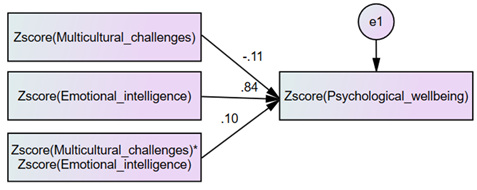
Table 8
|
Table 8 Regression Weights: (Group
Number 1 - Default Model) |
||||||
|
Path |
Standard Estimate |
S.E. |
C.R. |
P |
||
|
ZPsychological wellbeing |
<--- |
Multicultural challenges |
-0.113 |
0.024 |
-4.287 |
*** |
|
ZPsychological wellbeing |
<--- |
ZEmotional
intelligence |
0.844 |
0.025 |
32.104 |
*** |
|
ZPsychological wellbeing |
<--- |
Interaction |
0.102 |
0.023 |
3.888 |
*** |
The verification of critical pathways is made possible by this comprehensive analysis, which accounts for measurement errors and feedback inside the model. The path analysis revealed a negative association (β= -0.113, P<0.05) between the Zscores for intercultural issues and psychological wellness, which is meaningful from a statistical perspective. Between the Zscore for emotional intelligence and the Zscore for psychological wellbeing, there is a very significant association (β= 0.844, P<0.05).
Moderation testing
For the purpose of the moderation analysis, the following components are considered independent variables: Zscore (Emotional intelligence), Zscore (Psychological wellbeing), and Zscore (Multicultural challenges). The results are influenced by the standardized scores of the variables that are used to generate interaction terms in SPSS.
Table 9
|
Table 9 Regression Weights: (Group
Number 1 - Default Model) |
||||||
|
Path |
|
|
Standard Estimate |
S.E. |
C.R. |
P |
|
ZPsychological wellbeing |
<--- |
Interaction |
0.102 |
0.023 |
3.888 |
*** |
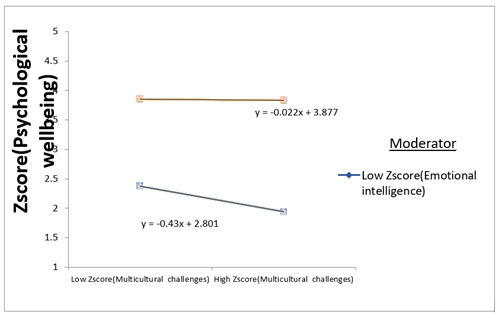
As a moderator, we examined the Z score (EQ). The results show that the psychological wellbeing Z score is positively and significantly impacted by the interaction term of the multicultural problems and emotional intelligence Z scores (β= 0.102, P<.05). The findings provide statistical evidence that Z score (Emotional Intelligence) acts as a moderator in our dataset.
5. Discussion
Findings from this study highlight the complexity
of the interplay among emotional intelligence, psychological health, and
cross-cultural difficulties. Cultural misunderstanding, communication
obstacles, and trouble adapting to new conditions all contribute to the decline
in emotional stability and life satisfaction among students, with a resultant
negative effect on their psychological health, according to the research. This
agrees with findings from other studies that suggest that greater exposure to intercultural
stresses could affect the mental health and social adjustment of the subjects.
The negative relationship between intercultural problems and emotional
intelligence suggests that persons who are experiencing significant cultural
challenges might struggle in managing, expressing, and understanding emotions
properly. That is to say, cultural stresses weaken the emotional management and
adaptability of pupils and decrease their ability to react productively toward
social diversity. The moderating study discovered that emotional intelligence
significantly reduces the effect of cross-cultural challenges on mental health.
Students with high levels of emotional intelligence are better able to manage
the stresses of interacting with people from various cultural backgrounds, form
meaningful connections, and prioritize their own psychological and emotional
well-being. Emotional intelligence, therefore, is a psychological attribute
supportive of dealing with cultural obstacles and sustaining wellness. Results
indicate that although there are considerable challenges presented by the
multicultural culture, emotional intelligence helps kids convert these
experiences into development and resilience opportunities. Of importance will
be a focus by universities in designing programs aimed at building emotional
intelligence skills among students to help them engage in healthy adjustment,
intercultural understanding, and general psychological well-being in an
increasingly diverse academic setting.
6. Conclusion
The study investigated the impact of multicultural university contexts on students' emotional intelligence, their mental health, and their intercultural problem-solving capabilities. The findings indicated that multicultural issues are negatively related to mental health and life happiness. As might be expected, students will have problems in adapting to new cultures, which means problems in communication, different social behaviors, and stressors of adaptation. In turn, intercultural issues were found to relate negatively to emotional intelligence, which indicates that children who have more cultural problems may fail in recognizing, understanding, and regulating their feelings adequately in different social situations. On the positive side, the research has identified emotional intelligence as an important moderator in this relationship. Students scoring high on emotional intelligence abilities were found to be better in recovering from the psychological damage caused by cultural barriers. In other words, emotional intelligence acts as a protective variable since it furnishes individuals with the ability to cope with difficulties due to cultural differences and with interpersonal interactions better. The overall structural model presented a very good fit and provided support for the notion that the proposed associations are theoretically and statistically significant. What these findings suggest is that teaching the emotions to the child ensures well-being for students in diverse educational contexts. Universities can contribute much to such a context through developing programs in emotional intelligence, training in cultural sensitivity, and supportive counseling for students as they face intercultural problems. It follows from this that even though a multicultural context carries certain psychological and emotional risks, robust emotional intelligence renders the students more capable of preserving their mental well-being, of adapting effectively, and of thriving in diverse university contexts.
CONFLICT OF INTERESTS
None.
ACKNOWLEDGMENTS
None.
REFERENCES
Abacioglu, C. S., Epskamp, S., Fischer, A. H., and Volman, M. (2023). Effects of Multicultural Education on Student Engagement in Low- and High-Concentration classrooms: The Mediating Role of Student Relationships. Learning Environments Research, 26(3), 951–975. https://doi.org/10.1007/s10984-023-09462-0
Al-Qadri, A. H., and Zhao, W. (2021). Emotional Intelligence and Students’ Academic Achievement. Problems of Education in the 21st Century, 79(3), 360–370. https://doi.org/10.33225/pec/21.79.360
Blasco-Belled, A., and Alsinet, C. (2022). The Architecture of Psychological Well-Being: A Network Analysis Study of the Ryff Psychological Well-Being Scale. Scandinavian Journal of Psychology, 63(3), 199–207. https://doi.org/10.1111/sjop.12795
Çarkçı, F. (2024). The Mediating Roles of Perceived Cultural Distance and Perceived Social Support in the Relationship Between Acculturative Stress and General Adaptation of International Students in Türkiye. Middle East Technical University (Turkey).
Chaudhry, S., Tandon, A., Shinde, S., and Bhattacharya, A. (2024). Student Psychological Well-Being in Higher Education: The Role of Internal Team Environment, Institutional, Friends and Family Support and Academic Engagement. PLOS ONE, 19(1), e0297508. https://doi.org/10.1371/journal.pone.0297508
D’souza, J. B., Dechpanprasong, W., Chan, C., and Ornla-or, R. (2023). Cultural Adaptation: A Mediator Between Cultural Intelligence and Academic Performance in a Thai Context. Asia Social Issues, 16(5), e258480. https://doi.org/10.48048/asi.2023.258480
Fu, L. (2025). The Role of STEM Teachers’ Emotional Intelligence and Psychological Well-Being in Predicting Their Artificial Intelligence Literacy. Acta Psychologica, 253, 104708. https://doi.org/10.1016/j.actpsy.2025.104708
González-Castro, J. L., Ubillos Landa, S., Puente Martínez, A., and Vera Perea, M. (2020). The Role of Emotional Intelligence and Sociocultural Adjustment on Migrants’ Self-Reported Mental Well-Being in Spain: A 14-Month Follow-Up Study. International Journal of Environmental Research and Public Health, 17(4), 1206. https://doi.org/10.3390/ijerph17041206
Hammoudi Halat, D., Soltani, A., Dalli, R., Alsarraj, L., and Malki, A. (2023). Understanding and Fostering Mental Health and Well-Being Among University Faculty: A Narrative Review. Journal of Clinical Medicine, 12(13), 4425. https://doi.org/10.3390/jcm12134425
Hong, K. T., Ng, S. I., and San Lai, P. (2021). International Students’ Cross-Cultural Adjustment: Determining Predictors of Cultural Intelligence. Indonesian Journal of Social Research, 3(1), 27–47. https://doi.org/10.30997/ijsr.v2i3.82
Javaid, Z. K., Mubashar, M., Mahmood, K., Noor, A., Javed, N., Akhtar, K., and Ali, A. L. (2024). Effect of Emotional Intelligence and Self-Concept on Academic Performance: A Systematic Review of Cross-Cultural Research. Bulletin of Business and Economics, 13(2), 189–199. https://doi.org/10.61506/01.00315
MacCann, C., Jiang, Y., Brown, L. E. R., Double, K. S., Bucich, M., and Minbashian, A. (2020). Emotional Intelligence Predicts Academic Performance: A Meta-Analysis. Psychological Bulletin, 146(2), 150–186. https://doi.org/10.1037/bul0000219
Moeller, R. W., Seehuus, M., and Peisch, V. (2020). Emotional Intelligence, Belongingness, and Mental Health in College Students. Frontiers in Psychology, 11, 93. https://doi.org/10.3389/fpsyg.2020.00093
Molina Moreno, P., Fernández Gea, S., Molero Jurado, M. del M., Pérez-Fuentes, M. del C., and Gázquez Linares, J. J. (2024). The Role of Family Functionality and its Relationship with Psychological Well-Being and Emotional Intelligence in High School Students. Education Sciences, 14(6), 566. https://doi.org/10.3390/educsci14060566
Piñeiro-Cossio, J., Fernández-Martínez, A., Nuviala, A., and Pérez-Ordás, R. (2021). Psychological Well-Being in Physical Education and School Sports: A systematic review. International Journal of Environmental Research and Public Health, 18(3), 864. https://doi.org/10.3390/ijerph18030864
Shengyao, Y., Xuefen, L., Jenatabadi, H. S., Samsudin, N., Chunchun, K., and Ishak, Z. (2024). Emotional Intelligence Impact on Academic Achievement and Psychological Well-Being Among University Students: The Mediating Role of Positive Psychological characteristics. BMC Psychology, 12(1), 389. https://doi.org/10.1186/s40359-024-01886-4
Tajvar, M., Atashbahar, O., Ahmadizadeh, E., and Shaqura, I. (2024). Exploring the Level and Sources of Stress Among International Students in an Iranian University. Journal of International Students, 14(4), 781–800. https://doi.org/10.32674/jis.v14i4.6650
Tran, N. T., Franzen, J., Jermann, F., Rudaz, S., Bondolfi, G., and Ghisletta, P. (2022). Psychological Distress and Well-Being Among Students of Health Disciplines in Geneva, Switzerland: The Importance of Academic Satisfaction in the Context of Academic Year-End and COVID-19 stress on their learning experience. PLOS ONE, 17(4), e0266612. https://doi.org/10.1371/journal.pone.0266612
Xiaoying, H., Baharom, S., and Sunjing, L. (2023). A Systematic Literature Review of the Relationship Between Cultural Intelligence and Academic Adaptation of International Students. Social Sciences and Humanities Open, 8(1), 100622. https://doi.org/10.1016/j.ssaho.2023.100622
|
|
 This work is licensed under a: Creative Commons Attribution 4.0 International License
© ShodhPrabandhan 2025. All Rights Reserved.